The Nightmare of Going Viral
Imagine this scenario: You just launched your most anticipated product. You are spending $5,000 a day on ads, an industry influencer just retweeted your link, and a massive email broadcast just went out. Traffic is flooding into your funnel at an unprecedented rate. This should be your most profitable day of the year. Instead, your phone buzzes with a devastating alert: '508 Resource Limit Reached' or 'Error 502 Bad Gateway'.
Your website has collapsed under the weight of its own success. Thousands of red-hot leads are staring at a blank error screen. Your ad spend is vaporized, and your brand reputation takes a massive hit. In the realm of dynamic hosting, this scenario is a mathematical inevitability when traffic scales too fast. Today, we explain why Static Funnels completely eliminate server crashes from your list of worries.
The Anatomy of a Server Crash
To understand why dynamic websites crash, you have to look at the 'Database Connection Pool'. When you use a CMS like WordPress, every single visitor triggers a unique request to the server's CPU and memory, which then must open a connection to the database to retrieve the page content.
Servers have a hard limit on how many concurrent database connections they can handle (often just a few hundred on standard hosting). If 10,000 people click your link within a two-minute window, the server attempts to open 10,000 simultaneous connections. The database panics, locks up, and the server runs out of RAM, resulting in an immediate crash. Even with heavy caching plugins, the moment the cache expires and needs to be rebuilt (a phenomenon known as 'cache stampede'), a traffic spike will blow right through it and kill the database.
The Static Solution: Decoupling Traffic from Computing
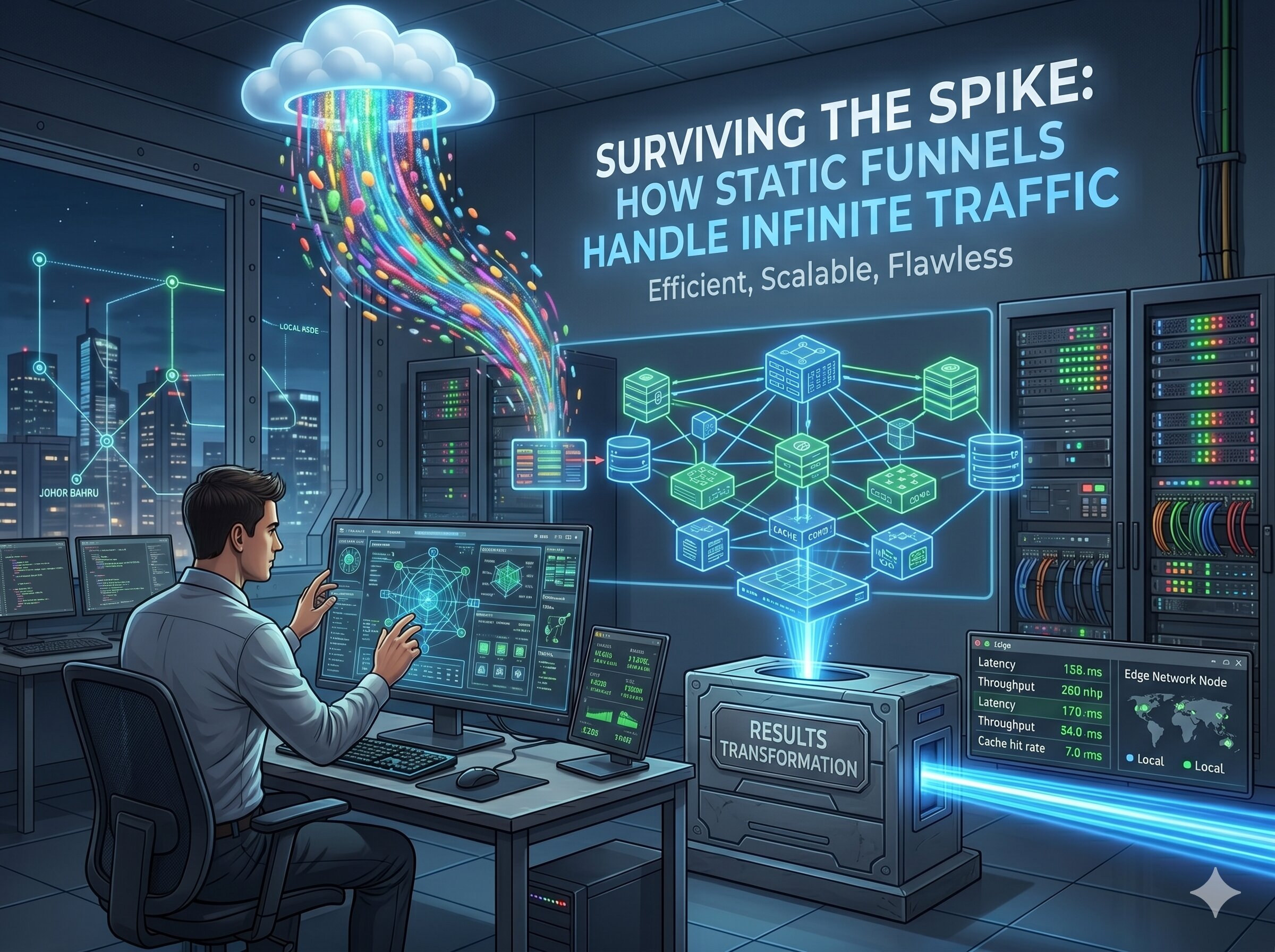
Static Funnels solve this problem by removing the fragile components from the equation entirely. Because your funnel is composed of pre-rendered HTML files, there is no database to query and no PHP code to execute.
When 10,000 visitors hit a static page simultaneously, the server doesn't process anything; it simply reads a text file and sends it 10,000 times. It is a pure data-transfer operation, which requires a fraction of a percent of the computational power needed by a dynamic site.
Infinite Auto-Scaling via Edge Networks
The true invincibility of Static Funnels comes from their deployment on Content Delivery Networks (CDNs) like Cloudflare or AWS CloudFront.
When your funnel is static, it isn't hosted on one vulnerable server in a single data center. It is duplicated and cached across hundreds of massive data centers globally. When a massive traffic spike occurs, the CDN's intelligent routing automatically distributes the load.
If a million visitors hit your site, the requests are seamlessly absorbed by servers in Tokyo, London, New York, and Sydney simultaneously. Modern CDNs have bandwidth capacities measured in Terabits per second—enough to absorb massive DDoS attacks from state actors. A successful ad campaign doesn't even make them flinch.
Conclusion: Buying Media with Confidence
If your infrastructure dictates your ceiling, you will always be afraid to scale your ad spend. Migrating to a Static Funnel provides absolute technical certainty. Whether you are driving 100 clicks a day or 100,000 clicks an hour, the page will load instantly, every single time. Stop worrying about server uptime, and start worrying about how you are going to fulfill all the orders.